Resolve trigger points in the jaw - and why massage has more effect than you think
Did you know that octopuses three hearts have? Two pump blood to the gills, one to the rest of the body. Crazy, right? Three hearts, three tasks - and here we are: your jaw, your neck and your back also work in a trio. If one gets out of sync, the others get out of sync. That's exactly what we're talking about today: Jaw tension, teeth grinding (bruxism) – and how targeted massage helps, Resolve trigger points in the jaw. Reading tip: From head to toe – your introduction to holistic health. Why your jaw “grinches” so often If...

Did you know that octopuses three hearts have? Two pump blood to the gills, one to the rest of the body. Crazy, right? Three hearts, three tasks - and here we are: your jaw, your neck and your back also work in a trio. If one gets out of sync, the others get out of sync. That's exactly what we're talking about today: Jaw tension, teeth grinding (bruxism) – and how targeted massage helps, Resolve trigger points in the jaw.
Reading tip: From head to toe – your introduction to holistic health.
Why your jaw “grinches” so often
If you wake up in the morning with tired cheeks and a buzzing head, there's a good chance your chewing muscles are working overtime at night. What begins in sleep continues during the day: unconsciously Jaw clenching when reading emails, concentrating, doing sports or when you “just briefly” raise your shoulders.
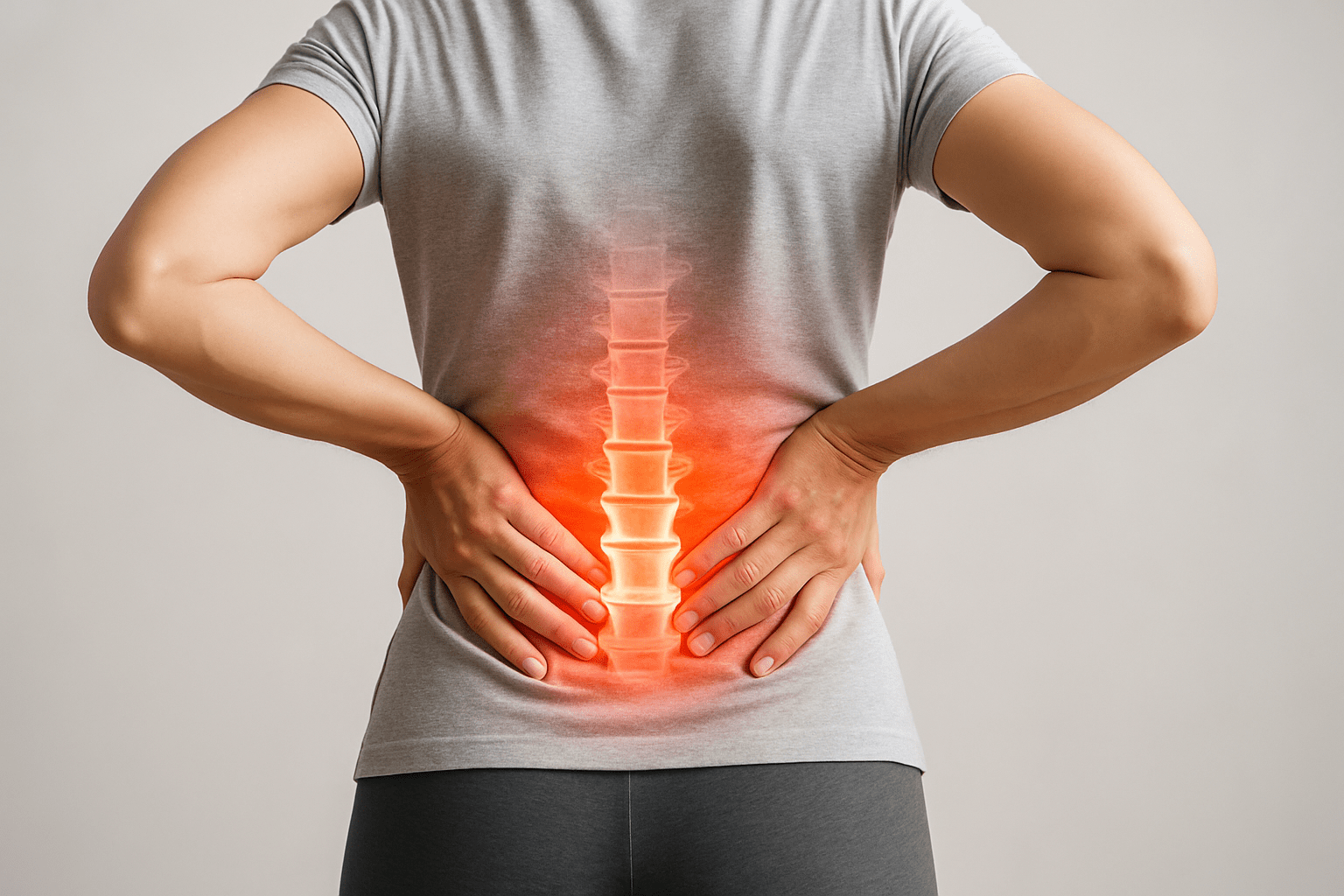
Stress, sleep problems, prolonged sitting, screen work and dental/bite factors are among the most common triggers. They are often affected chewing muscles (Masseters, Temporalis, Pterygoid). The tension pattern migrates over neck, neck and shoulders continue – Headache, Ear and facial pain, neck and even Back pain inclusive.
A practical image for this: imagine the muscles like this pull rope before. If you pull on one end (jaw), the tension along the Fascia and muscle chains passed on (neck/neck/shoulder). That's exactly why it's rarely enough to just "work on your jaw" - it's often necessary Combination from jaw, neck and shoulder massage, relaxation and good sleep hygiene.
Mini self-check (30 seconds):
-
Bite test: Are your teeth just touching? (When idle they should slightly separated be.)
-
Forehead & Temple Scan: Do you feel a subtle Constant tension?
-
Shoulder status: Are the shoulders above instead of consciously below?
-
Screen mode: chin pushed forward? (Especially typical when holding a laptop.)
If the topic pleases you “Tension chains” interested, read accompanying:
In short: Your jaw rarely grinds “alone.” The better you are Connections understand, the more targeted you can be, specifically where the tension is arises and where they are holds on.
This turns “I’m tense” into “I’m tense”. “I specifically solve the right points” will, let's take a look now, where the tension is there and like you can loosen them with simple handles.
Recognizing trigger points in the jaw - and what they have to do with your everyday life
Maybe you know this feeling: You're sitting intently at your laptop, reading an email - and suddenly you notice that you're clenching your jaw tightly. No sound, no crunching - just pressure. Seconds later, you tense your shoulders, pull your neck forward a little, and your whole body seems to say, “Hold on!”
This is the moment when Trigger points arise. Small, overstimulated muscle areas that feel like tiny knots or hard points in the tissue. They arise when muscles are overloaded or permanently tense, for example Stress, poor posture or grinding your teeth at night. In the jaw, this mainly affects three muscle groups:
-
Masseters - the strongest chewing muscle - runs along the edge of the cheek under the cheekbone. When it is tense, you often feel pressure or dull pain in your face, teeth, or ear.
-
Temporalis – the temporalis muscle. When stressed, it often feels “hardened,” which can lead to headaches and pressure in the temples.
-
Pterygoid muscles – deep inside, near the jaw joint. If they tense up, it can cause jaw clicking, restricted movement and ringing in the ears (tinnitus).
The masseter is - based on its size - one of the strongest muscles in the human body. It can generate a bite force of up to 80 kg. Imagine this muscle working unconsciously for hours at night against the resistance of your own teeth - no wonder it protests in the morning.
How trigger points become noticeable
A typical character is a dull, pulling pain, which does not always occur where it originates. If you press on the masseter sideways, you may feel the pain in the teeth or on the temple feel - that's what you call referred pain. Many people confuse this with a toothache or migraine, even though the origin is muscular.
Also Cracking sound when opening mouth, limited jaw mobility or a Feeling of heaviness in the face can be an indication of overactive trigger points.
Why massage is so effective here
Trigger points respond surprisingly well mechanical stimulus, i.e. gentle pressure, rhythmic movement or warmth. Massage will:
-
the blood circulation improved in muscle,
-
Metabolic waste products transported away,
-
the Muscle tone lowered,
-
and that Nervous system calms.
In short: the muscle learns to let go again. Studies show that regular massage the chewing muscles reduce the tension by up to 70 % can reduce - especially if you use it Breathing exercises, warmth and neck relaxation is combined [2][3][7].
Gentle self-awareness: your jaw compass
Before you work with targeted techniques, it's worth taking a minute to listen to yourself:
-
How does your jaw feel right now? Relaxed or “tense-neutral”?
-
Are your teeth separated? (This is what they should be at rest.)
-
Do you feel a difference when you consciously breathe out deeply?
This little self-awareness is like a reset. Because the truth is: your jaw isn't grinding against you - it's trying to protect you. But sometimes he needs a reminder of when he can let go.
Resolve trigger points in the jaw – massage instructions step by step

Now that you know where the tension comes from and where she sits, let's get to the best part: this Solve. Don't worry - you don't need professional hands or expensive equipment. What matters are Mindfulness, gentle routine and knowing when you Take out pressure instead of pushing in.
Imagine the process like a little evening routine: a ritual that calms you down mentally and relieves you physically. Ideal after a long day at work, before bed or after intense screen time.
Step 1: Heat & Loosen (2-3 minutes)
Before you massage, give your jaw a treat Heat break:
-
A warm cloth or heating pad The tissue is “soft” on the cheeks and neck.
-
Let your lower jaw hang slightly, your lips closed, Teeth separated!
-
Breathe in and out deeply. Feel how the warmth slowly sinks into the muscles.
Pro tip: If you regularly suffer from tension, you can keep a warm cherry stone bag or a damp towel handy in your everyday life. Five minutes is often enough to noticeably reduce the pressure on your face.
Step 2: Find the masseter – your main player
The Masseters is the strongest chewing muscle and at the same time one of the main causes of jaw tension.
This is how you find it:
-
Place your fingers on your cheek, just below your cheekbone.
-
Bite lightly - you will feel a muscle bulge.
-
That's exactly where you start:
-
With two to three fingers gentle, circular movements execute.
-
Stroke from the back (corner of the jaw) to the front (towards the corner of the mouth).
-
Pressure: pleasant, never painful.
If you hit a tender spot, hold pressure 10-20 seconds and keep breathing calmly. Often you will feel the point “give” – that’s it Releasing the trigger point, almost “melting in the muscle”. You can really feel how the chewing muscle stops fighting - as if it were letting out a long sigh.
Step 3: Relax the temporalis muscle
Often underestimated, but crucial: The Temporalis extends over the temples to the hairline.
This is how you do it:
-
Place your index and middle fingers on your temples.
-
Gentle circles upwards towards the back, then downwards slightly towards the front.
-
60-90 seconds long.
-
Breathe evenly and keep your neck relaxed.
Many report that this... Tension headaches or Feelings of pressure behind the eyes noticeably decrease.
Tip: If you like, you can do something Facial oil or cream Use - this reduces friction and makes the movement more fluid.
Step 4: Connection to the neck – the relief factor
If you only treat the jaw, you often only solve part of the problem. The rest “pulls” from below.
Therefore:
-
Massage gently along the base of the neck from the back of the head towards the shoulder.
-
Work with slow, long strokes.
-
Consciously let your shoulders sink.
If you have one Massage chair If you have, use programs like this Shiatsu or Deep Tissue, which appear particularly deep in the neck area.
→ Or discover it MSW-300 massage chair, which was developed precisely for such muscle chains:
Step 5: Stretch & Trace
To conclude:
-
Open your mouth slowly until just before the pain point.
-
Hold for 3 seconds, close. Repeat 5-6 times.
-
Place your fingertips loosely on your cheeks and feel.
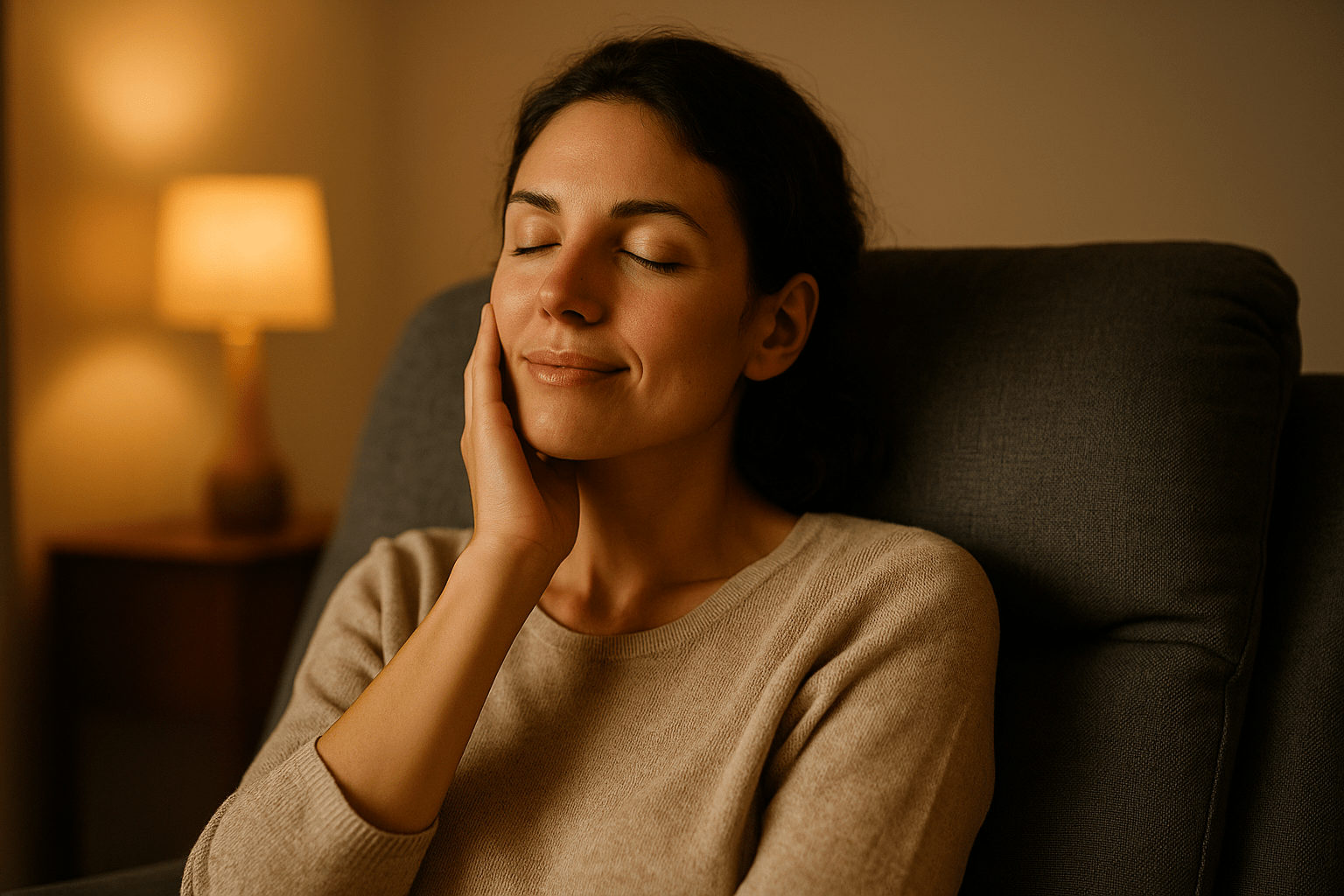
What do you feel now? Maybe warmth, tingling or just calm. This is your body coming back into balance.
Remember: Relaxation is not a “goal”, but a signal: your nervous system has registered that you are safe and can let go.
Routine & suitability for everyday use
-
Evening: 5-10 minutes is enough. Best done right after brushing your teeth or before sleeping.
-
During the day: Whenever you notice that you are chewing even though there is no food - consciously relax.
-
Long term: The more regularly you massage, the fewer trigger points will form.
Resolving trigger points in your jaw isn't a science - it is mindful body work. With a little patience, warmth, and conscious touch, you can teach your jaw to trust again.
And when you connect it to the rest of your body – neck, shoulders, back – a cycle of relief is created.
Aids & devices: massage chairs, massage guns etc. – what really helps
Of course, you can relax your jaw wonderfully with your hands. But sometimes the body longs for more: for constant, profound reliefthat you cannot create yourself. Come here Aids and massage devices into the game. They extend the effect of your routine and reach muscle chains that you can hardly reach manually.
The massage chair – relaxation from head to toe
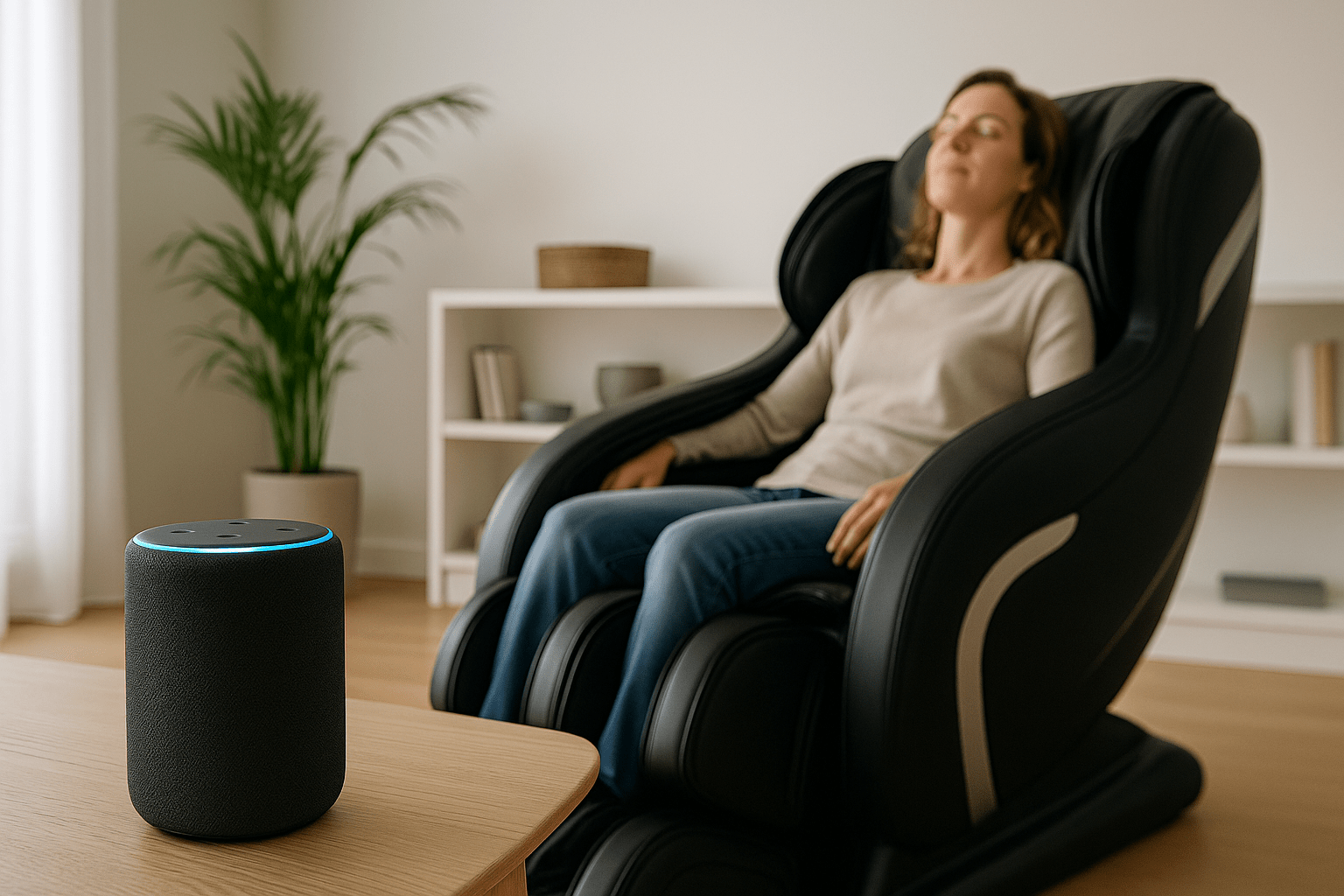
Perhaps the most underestimated helper against jaw stress is this Massage chair. Sounds like luxury? True, but according to medically sensible luxury. Tensions in the jaw rarely arise in isolation. You are part of a system that... Neck, neck, back and shoulders is connected to each other.
If you regularly put your body in one Massage chair you treat not just the symptoms, but the whole thing voltage path. The following are particularly effective:
-
Shiatsu massages: Rhythmic pressure on acupressure points that goes deep into the tissue - perfect for tense neck and shoulder muscles, which often trigger jaw stress.
→ Read more here: Shiatsu – the art of printing -
Deep tissue programs: strong, slow massage movements along the fascia. They loosen sticky structures and bring the entire muscle network back into length.
→ More about this: Deep tissue massage – how it works -
Neck and shoulder programs: Heat, kneading and rolling movements loosen precisely those regions that are functionally connected to the jaw.
A model that is often recommended in this context: the Massage chair World MSW-300. He combines Shiatsu, air pressure and deep tissue programs – ideal for anyone who regularly takes Jaw, neck or back tension suffer.
Current studies show that regular full body massage not only muscle tone, but also Stress hormones such as cortisol can reduce [2][3][7].
Massage guns – targeted help with sensitivity
Massage guns are great when you're doing spot work, but you need to be careful around the facial area.
The following applies here: gentle, short and indirect.
This is how it works correctly:
-
Choose that one softest attachment (usually the flat or round one).
-
Put the lowest level a.
-
Treat not directly the edge of the jaw, but the Chewing muscles on the cheek as well as the Neck base.
-
Maximum 30 seconds per zone, then pause.
It's best to combine the massage gun with gentle hand movements, it works like a massage gun Turbo for blood circulation.
Read here how to use them correctly: Massage gun – application & effect
Expert tip: If you regularly work on your PC, use the gun for that too Scapular region. It is often the “anchor” for neck tension that affects the jaw.
More tools & little helpers
In addition to massagers, there are simple everyday helpers that are surprisingly effective:
-
Heat pads or heat cushions: ideal before every jaw massage.
-
Fascia balls or soft rolls: Roll gently along the jawline or at the base of the neck.
-
RelaxBogen® – a specially developed device that stimulates pressure points on the jaw. Studies show that it can significantly reduce pain and tension in the chewing muscles and neck [7][8].
Massage + relaxation = double effect
Whether by hand, pistol or armchair – massage has a more lasting effect if you do it with you Relaxation techniques combine.
For example:
-
4-7-8 breathing (inhale 4 seconds, hold 7 seconds, exhale 8 seconds)
-
Progressive muscle relaxation according to Jacobson
-
Short mindfulness breaks in between
These methods lower the basic tension level in the nervous system - and that is the actual source of bruxism.
If you want to know more about the connection between massage and the nervous system: Effect of massage on the nervous system
Massagers are not a “shortcut”; Supplement. They'll help you stick with it, even on days when you don't feel like manual self-massage. Whether you sink into a massage chair or use a massage gun: This is what matters Regularity. Because the goal remains the same: less pressure, more lightness - in the jaw, in the neck, in the whole body.
Typical mistakes when it comes to jaw pain – and how to avoid them
Even though jaw massages may look simple, the small details often make the big difference “Aha, that feels good” and “Ugh, that was too much”. Here are the most common pitfalls and how you can easily avoid them:
1. Too much pressure
A bit of “well-sickness” is allowed, but a stabbing pain is a warning signal.
Many believe they need the tension push out. But muscles are not concrete blocks, but sensitive tissue with fine nerve pathways. Too much pressure can Counter tension trigger, the muscle reflexively contracts even more strongly.
Better: Work below the pain threshold. If you can still breathe calmly during the massage, you are in the green zone. Imagine you are “coaxing” the muscle to let go – you are not forcing it.
2. Work on the jaw only
The jaw is rarely the actual problem, it is just the valve. If you just work there, he stays Pull on the muscle chain consist: from the neck over the shoulders to the upper back. The result? As soon as the jaw is loosened, it tightens again from behind.
It would be better if you relate Neck, shoulders and upper back areas with one. Just a few minutes of neck massage, whether with your hands, a massage gun or a Massage chair, often solve the jaw region indirectly.
Remember: relaxation rarely works locally, but rather systemic.
3. Irregularity
“I did it once – it didn’t help.” Do you know that?
Massage is not a sprint, but Muscle care. Your body learns through repetition that it can let go. A single session can provide short-term relief, but for now Regularity changes the basic tension.
Better: Tarpaulin short, daily routines: 5-10 minutes in the evening is enough.
Like brushing your teeth: it's better to do it briefly every day rather than once a week for a long time.
After just two weeks, many people report that morning jaw pain has subsided significantly.
4th rail = solution?
One Bite splint protects your teeth – no question. But it doesn't automatically take away the tension from the muscle. Many believe that the splint “cures” bruxism. In fact, it just prevents you from damaging your teeth and dentures. The Causes – Stress, poor posture, muscular imbalances – remain.
Better: Consider the rail as Part of an overall plan.
Combine them with:
-
regular jaw and neck massage
-
Heat applications
-
Stress reduction and relaxation techniques
-
if necessary, physiotherapeutic support
This means the splint becomes protection, not a crutch.
Jaw massage is not a science - but it thrives Sensitivity.
If you learn to listen to your body's reactions, you will quickly notice: your jaw tells you pretty much exactly what it needs.
Try to see these routines not as chores, but as Mini times for yourself. Two hands, five minutes, a little warmth, and your whole body benefits.
Stress, sleep & posture: How to relax your jaw in everyday life
Massage is powerful - but it works best when you do it in one relaxed everyday life embed. Jaw stress rarely occurs in the masticatory muscle alone. It begins in the head: in thoughts, to-do lists and small tensions that creep unnoticed into the body.
So with every conscious pause, every breath and every upright posture you can help your jaw finally “breathe” again.
Stress management – the real game changer
Bruxism is often your body’s silent language for “too much.” The first step: perceive instead of pushing away.
Here's how you can actively counteract it:
-
Microbreaks: Pause briefly every 30 minutes, circle your shoulders, and relax your jaw.
-
Jaw code: Whenever you unlock your phone or open an email – check: Are my teeth separated?
-
Breathing anchor: 4-7-8 breathing – in for four seconds, hold for seven, out for eight. After three rounds, your parasympathetic nervous system (the relaxation nerve) is active.
-
Mental looseness: Pay attention to your inner dialogue. We often binge ourselves not only physically, but also mentally.
Psychologist Katharina L., an expert in stress management, says:
"The jaw is like a barometer for internal pressure. If you learn to consciously relax it, you regulate your entire stress system."
Sleep & evening routine – the key to regeneration
Many people grind at night because the body “works off” the day’s stress while sleeping. Good sleep hygiene is therefore almost as important as the massage itself.
How to sleep your jaw loose:
-
A fixed sleep routine: Go to bed at the same time if possible.
-
No blue light (smartphone/PC) 60 minutes before sleep.
-
Just before you lie down:
-
Warmth on cheeks and neck
-
5 deep breaths
-
Gently “drop” the lower jaw – the brain learns: Now it's quiet.
-
If you like, add one short jaw massage or a ten minute one Shiatsu massage in a massage chair.
→ Inspiration: From head to toe – discover holistic relaxation
Posture & everyday life – small corrections, big impact
Your workplace is often the invisible player in the jaw story. A slightly forward head position increases the pressure on the chewing muscles - up to 30% more muscle tone according to studies.
This is how you bring posture into relaxation:
-
screen on Eye level – no constant looking down.
-
Lean your back, feet flat, shoulders relaxed.
-
Jaws regularly “uncouple”: lips closed, teeth separated.
-
Ergonomic tools like Massage chairs or mobile massage pads can help relieve neck and shoulder strain during everyday work.
→ Suitable programs: Health collection from massage chair world
Mindfulness for everyday life
Tension is not just muscle, but also Attention patterns. If you learn to notice your jaw before it tenses, you've taken the crucial step.
Try these mini exercises:
-
When brushing your teeth: pause briefly and consciously relax your jaw.
-
When driving or waiting at a traffic light: “Tongue loose, teeth separated.”
-
When talking on the phone: smile consciously or open your mouth slightly - this relaxes the entire facial and neck muscles.
Your body is a system, not a puzzle
Our body is a finely tuned system - as precise as a living being that works with multiple hearts. We also have something like three “heart chambers” of tension: jaw, neck and back. They beat in the same rhythm, and if one of them gets out of rhythm, the others stop with it.
Jaw tension and teeth grinding are not an isolated problem, but a reflection of how we live, work and deal with pressure. If you learn to perceive the body's signals early on, you can make big changes with small routines: a short massage, conscious breathing, warmth, mindfulness.
Whether with your hands, a massage chair or a breathing exercise – it is crucial that you regularly give your body space to let go. Just as three hearts only keep life moving together, true relaxation only occurs when the jaw, neck and back work in the same rhythm.
And that's exactly when what it's really about happens: you feel lightness - in your body, in your head and in everyday life.
Final tip: If you would like to know how massage programs can change your everyday life in the long term, browse through ours Health world from massage chair world – designed for relaxation from head to toe.
Mini FAQ
How can I “resolve jaw trigger points”?
With gentle, constant pressure on masseter/temporalis (10–20 seconds), quiet circles, slow spreading, plus Neck/shoulder also treat.
How often to massage if you grind your teeth?
8-10 minutes daily Experience has shown that evenings work better than long, infrequent sessions.
Does a massage gun help relieve jaw tension?
Yes – carefully and low dose on masseter (outside), neck/shoulder. No hard hits to the face.
Can a massage chair help with jaw tension?
Yes, especially programs for Neck/Shoulder, Shiatsu, Deep Tissueto the Basic tension to shut down.
Important note (disclaimer)
This article is for informational purposes and does not replace medical advice. If you have persistent symptoms, severe pain, jaw cracking, tooth damage or dizziness/tinnitus, please contact a dentist, ENT, physiotherapy or a CMD consultation.
Sources
[1] Recognize jaw tension and its significance early – Regensburg dentists
https://www.zahnaerzte-in-regensburg.de/wissenswertes/kieferverspannungen-und-ihre-bedeutung-fruehzeitig-erkennen
[2] Doctor, we have a crunch problem! – DocCheck
https://www.doccheck.com/de/detail/articles/49827-doktor-wir-haben-ein-knirsch-problem
[3] Relieve jaw tension – techniques (Dr. Barloi)
https://blog.drbarloi.de/blog/kieferverspannungen-loesen-techniken
[4] Teeth grinding (bruxism): causes, consequences, treatment – About Dents
https://about-dents.de/zaehneknirschen-bruxismus-ursachen-folgen-und-behandlung/
[5] Teeth grinding: Stress for the whole body – favorite dentist
https://www.lieblings-zahnarzt.de/lieblings-blog/zahn-und-zahnfleischerkrankungen/zaehneknirschen-stress-fuer-den-ganzen-koerper/
[6] Teeth Grinding – Symptoms, Causes & Treatment – Dr. Gal
https://www.drgal.de/blog/zahngesundheit/zaehneknirschen-symptome-ursachen
[7] The RelaxBogen® as a new therapeutic agent for bruxism & CMD – (dissertation/study)
https://d-nb.info/1109278950/34
[8] The RelaxBogen® as a new therapeutic tool – Springer Medicine
https://www.springermedizin.de/bruxismus/craniomandibulaere-dysfunktion-und-stress/der-relaxbogen-als-neues-therapiemittel-bei-bruxismus-und-cmd/10543430
[9] When the chewing muscles and jaw joints hurt – Mainz University Medical Center
https://www.unimedizin-mainz.de/fileadmin/kliniken/zmk/Dokumente/UM_Brosch_Kieferorth_A5_110722_V6_final_2022-07-21.pdf
[10] What can you do about grinding your teeth? – NetDoctor
https://www.netdoktor.de/symptome/zaehneknirschen-bruxismus/was-tun/
(Optionally additional if you want to reference them in the article:)
– S3 Guideline Bruxism (AWMF/DGFDT)
https://www.dgfdt.de/documents/266840/35559542/LL+Bruxismus/9d5c190f-af66-4110-aafc-c332d30bfb20
Mitgründer und Geschäftsführer der Massagesessel Welt. Mit seinem Expertenwissen und seiner Branchenkenntnis hilft er, Privatpersonen und Unternehmen zu passenden Massagesessels für Entspannung, Gesundheit und Vitalität zu finden. Die individuelle Fachberatung erfolgt sowohl telefonisch oder per Videochat, als auch in der Ausstellung vor den Toren Stuttgarts.